How to Buy Anthropic Stock on IPO Day: What Would You Actually Pay for ANT?
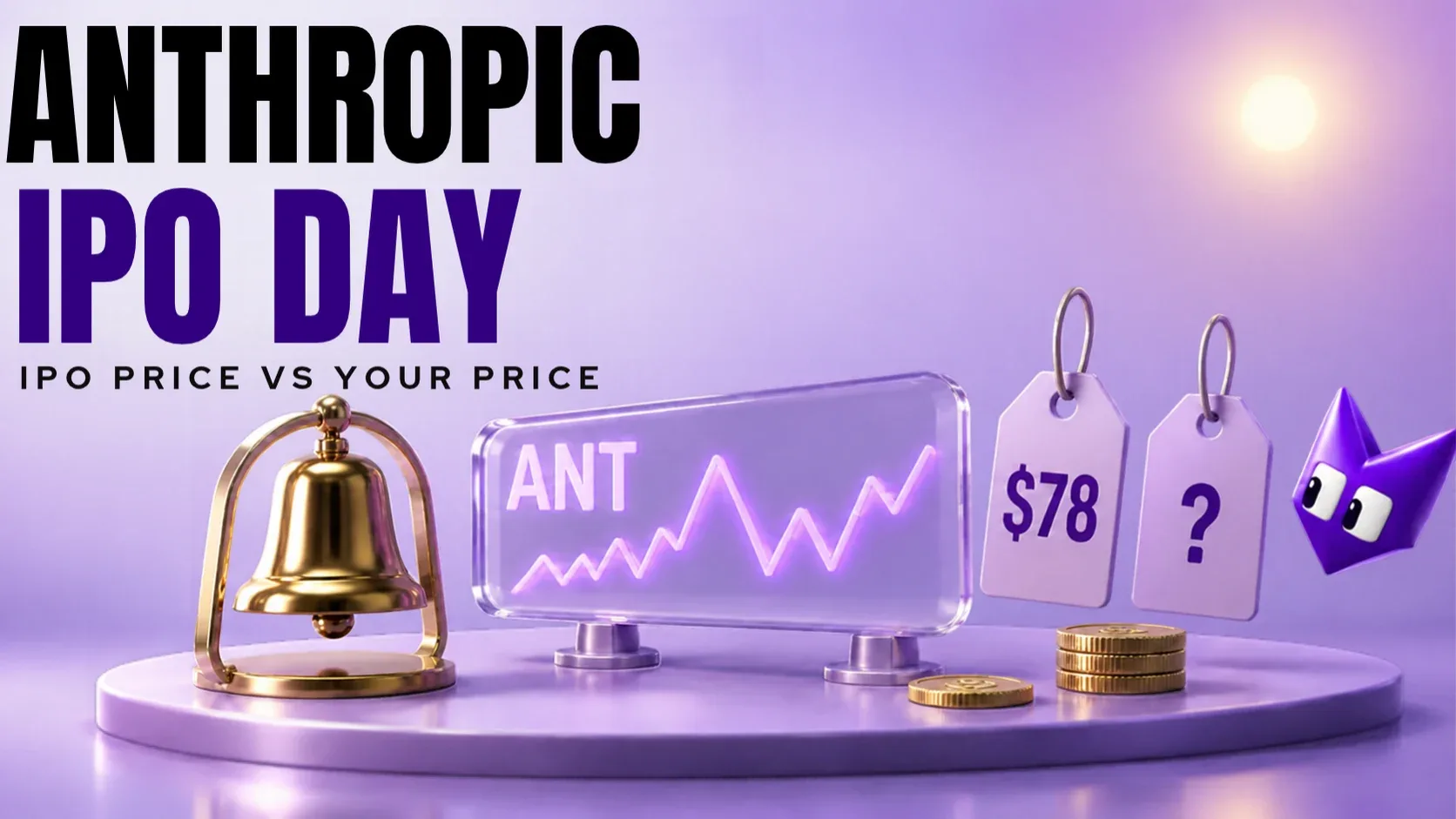
Anthropic's IPO price and your purchase price are two different numbers. Here is how allocations, the opening auction and order types decide what you pay.
Nevlin team12 min read





On this page12 sections
To buy Anthropic stock, most people will use a brokerage account once ANT starts trading on Nasdaq, expected Thursday, November 19. The IPO price, due Wednesday evening, applies only to investors who receive an allocation. Everyone else pays the market price once trading opens, which can be much higher or lower.
Part 3 of our Anthropic IPO coverage. Last updated November 17, 2026, before the final IPO price was set.
In Part 1, we traced where the Anthropic IPO money would go. In Part 2, NVIDIA showed why every price change needs a reference point. Now the two ideas meet in one practical question: what price would you actually pay for ANT stock?
The short answer is that the IPO price in the headlines and your purchase price are two different numbers. This guide explains why, using deal terms reported as of November 17 and clearly labeled examples.
Anthropic IPO price and date: where things stand
On Tuesday, Bloomberg reported that Anthropic was guiding investors to the top of its $70 to $78 range or higher (Bloomberg, November 17). CNBC, citing unnamed sources, reported that the Anthropic IPO price was likely to land above the range (CNBC, November 17).
That is guidance, not a final price. CNBC reported that order books would close at 4 p.m. ET on Tuesday, ahead of Wednesday's pricing.
| Item | Status as of November 17, 2026 | Source |
|---|---|---|
| Ticker and exchange | ANT on the Nasdaq Global Select Market | Anthropic |
| Filed price range | $70 to $78 per share | Anthropic |
| Latest guidance | Top of range or above; final price not set | CNBC |
| Final IPO price | Expected Wednesday evening, November 18 | CNBC |
| First trading day | Expected Thursday, November 19 | CNBC |
| Shares offered | 825,000,000 Class A shares, plus a 30-day option for up to 123,750,000 more | Anthropic |
| Separate private placement | $26 billion of Class N stock at the IPO price | CNBC, November 10 |
| Largest holders afterward | Amazon about 15% and Google about 14% of capital stock | Bloomberg, November 17 |
At the filed range, the 825 million shares would total $57.75 billion at $70 and $64.35 billion at $78, before costs. Part 1 explains why that total does not all go to the company.
How to buy Anthropic stock: two different routes
The SEC describes two ways the public can buy into a new public company (SEC Investor Bulletin: Investing in an IPO). They happen at different times and usually at different prices.
Route 1: an IPO allocation. If your broker takes part in the offering and you are eligible, you may be offered shares at the IPO price. The SEC notes that underwriters often place most shares with institutions and wealthy clients.
Route 2: the open market. Once ANT starts trading, anyone with a suitable brokerage account can place an order. The SEC calls this the more common route for individual investors.
| IPO allocation | Buying after trading opens | |
|---|---|---|
| Price | The final IPO price | The market price when your order fills |
| When | Confirmed around pricing, before trading begins | From the first trade on Thursday onward |
| Who can take part | Eligible clients of participating brokers | Most investors with an account that offers U.S. stocks |
| Guaranteed? | No. A request can be cut back or not filled | A market order usually fills, but the price is not guaranteed |
| Main risk | Getting fewer shares than requested, or none | Paying far more or less than the IPO price |
Anthropic is targeting about 20% of the offering for individual investors, people familiar with the plans told CNBC (CNBC, November 10). CNBC noted that a typical IPO sets aside 5% to 10%. A bigger retail share still guarantees nothing to any one investor.
Why demand can shrink your allocation
An offering is oversubscribed when investors ask for more shares than exist. The underwriters then decide who gets what, using what the SEC calls the "order book": the list of requests.
Here is a simplified picture. Suppose demand is six times the shares available and every request is cut by the same proportion. A request for 50 shares would shrink to about 8.33, rounded down to 8.
Hypothetical example. Real allocations are not split evenly, and many requests in a popular IPO receive nothing.
Brokers can also set their own conditions, such as account requirements or limits on selling soon after the debut. Your broker's IPO terms are the place to check.
Why Thursday's price may not be the IPO price
The company and its underwriters set the IPO price using market conditions, analysis and the order book. The SEC warns that this price "may bear little relationship to the trading price" once shares start trading.
On Nasdaq, a new listing opens through an auction called the IPO Cross. Buy and sell orders build up first, and the opening price is set where they meet (Nasdaq IPO Cross). So the first trade may come well after the 9:30 a.m. ET open.
SpaceX, the largest IPO before Anthropic, shows how far the first trade can move from the IPO price. It priced at $135 and first traded at $150 before noon on June 12, 2026, an 11.11% jump. It closed that day at $160.95 (IPO Scoop, June 12, 2026).
A strong first day does not tell you where a stock goes next. ANT could open above, at or below its IPO price.
What $2,000 buys at different prices
Imagine you set aside $2,000. How many whole shares you get depends entirely on the price when your order fills.
| Price per share | Whole shares | Amount spent | Cash left over | Compared with $78 |
|---|---|---|---|---|
| $70 (bottom of filed range) | 28 | $1,960 | $40 | 10.3% lower |
| $78 (top of filed range) | 25 | $1,950 | $50 | Same |
| $90 | 22 | $1,980 | $20 | 15.4% higher |
| $100 | 20 | $2,000 | $0 | 28.2% higher |
| $110 | 18 | $1,980 | $20 | 41.0% higher |
Hypothetical prices, not forecasts. Excludes fees. Brokers that offer fractional shares could use the leftover cash.
"ANT up 20%" may not describe your result
This is where the NVIDIA lesson from Part 2 comes back. Every percentage change needs a starting point. On debut day, headlines usually measure from the IPO price, not from the price you paid.
Picture a hypothetical day. The IPO prices at $80, the first trade happens at $100 and the stock closes at $96.
| Measurement | From | To | Change |
|---|---|---|---|
| Headline "first-day gain" | $80 IPO price | $96 close | +20.0% |
| First trade versus IPO price | $80 IPO price | $100 first trade | +25.0% |
| Your result if you bought at the first trade | $100 your price | $96 close | -4.0% |
Hypothetical prices for illustration only.
Buy 20 shares at $100 and you have paid $2,000; at the close they are worth $1,920, an $80 paper loss. Someone who got 20 shares at the $80 IPO price holds the same $1,920, a $320 paper gain. Same stock, same day, opposite results.
Market orders vs limit orders on a fast open
How you place an order matters as much as when. A market order is filled right away but "does not guarantee the execution price," Investor.gov explains (Investor.gov: Types of Orders). A limit order sets the highest price you will pay, so it controls the price but may not fill.
| Order type | What it does | What can happen on debut day |
|---|---|---|
| Market order | Buys as soon as possible at the current price | Can fill far above the IPO price if demand surges at the open |
| Limit order | Buys only at your price or lower | May never fill if the stock opens and stays above your limit |
Say you place a limit order at $90 and ANT first trades at $100. Your order waits unfilled. If the price later drops to $90 or lower, it could fill, buying 22 whole shares with a $2,000 budget.
Hypothetical example. Brokers may treat orders placed before a new listing opens differently.
Unless you choose otherwise, your broker will usually enter an order as a market order (Investor.gov: Market Order). On a volatile first day, it helps to know which type you are using.
Step by step: buying ANT stock after it starts trading
- Check your account. You need a brokerage account that offers U.S.-listed stocks. Access and rules differ by country and provider.
- Fund it ahead of time. Bank transfers can take a few business days to settle.
- Find the right ticker. Search for ANT and confirm the name is Anthropic, PBC.
- Wait for the first trade. Before the opening auction, you may see indicated prices, not real trades.
- Pick your order type. Choose between a market and a limit order, and note your maximum price.
- Review the confirmation. Check the number of shares, the price paid and any fees.
This describes the mechanics, not a suggestion to buy. Whether any single stock fits your plans is a separate question.
Risks to understand before day one
Price swings. The SEC warns that buying right after an IPO "can be risky." Underwriters may support the price in the first days, and once that ends the price "may decline significantly below the offering price."
Lock-up expiry. Insiders usually cannot sell for a set period after an IPO, and prices may drop when that period ends (Investor.gov: Lockup Agreements). For Anthropic, AP reported 180 days for directors, officers and holders of substantially all its stock. Co-founders and certain stockholders agreed to 365 days (AP via NY1, November 10).
CNBC reported that the $26 billion private placement shares are not covered by the underwriters' lock-up agreements (CNBC, November 10).
Revenue is growing, but the company reported a large loss. Anthropic reported $33.24 billion in revenue for the nine months to September 30, up roughly 1,200% from a year earlier. It also reported a $104 billion net loss, mostly from changes in the fair value of convertible notes and derivatives (CNBC, November 10).
Analyst estimates disagree. New Street Research started coverage with a buy rating and a $105 price target (CNBC, November 17).
Morningstar estimated fair value at $92, with a bull case of $188 and a bear case of $25 (Morningstar, November 12). Estimates are opinions built on each firm's assumptions. None of them tells you what your own purchase will return.
Concentration. Putting a large share of savings into one new stock means one company's news can move your whole portfolio.
You may already own a piece of this story
Amazon and Google are set to hold about 28% of Anthropic's capital stock combined, according to Bloomberg. Many broad U.S. stock index funds own Amazon and Alphabet, Google's parent, so a fund's holdings list shows that indirect exposure.
Before you place an order: five questions to ask yourself
| Question | Why it matters |
|---|---|
| What share of my savings would this be? | A single stock can fall sharply. Would a large drop affect my other plans? |
| How long could I leave this money invested? | First-day and lock-up swings matter less if I will not need the cash soon. |
| What is the most I am willing to pay per share? | A number written down before Thursday makes a limit order easier to set. |
| What would I do if it fell 20% after I bought? | On $2,000, a 20% fall leaves $1,600. Some people write their answer down in advance. |
| Have I read the risk factors in the prospectus? | The SEC says reviewing the prospectus is important before investing in an IPO. |
Keep learning the concepts behind the headline
New to terms like order book, limit order or lock-up? Nevlin's Investing course covers stock ownership, price changes, risk and related concepts through lessons and quizzes. It provides education and does not recommend specific investments.
Frequently asked questions
FAQ
When is the Anthropic IPO date, and when can I buy?
Pricing is expected Wednesday evening, November 18, and trading on Thursday, November 19, according to CNBC. The first trade depends on Nasdaq's opening auction and may come well after 9:30 a.m. ET.
What is the Anthropic IPO price?
The filed range is $70 to $78 per share, and reports say pricing may land at the top or above. The final price is expected Wednesday evening.
Can I buy Anthropic stock at the IPO price?
Only through an allocation from a broker taking part in the offering. Allocations are not guaranteed, and in a heavily requested IPO many requests are reduced or not filled.
Which brokers offer Anthropic IPO shares?
In the U.S., ask your own broker whether it is taking part and what it requires. For retail offerings abroad, Anthropic lists participating brokers by country, including the UK, EU, Canada, Australia and Japan (Anthropic Help Center). Listing a broker here is not an endorsement.
Can I buy Anthropic stock before the IPO or through a fund?
Be cautious. Anthropic says any unapproved sale of its stock is void and that it does not permit special purpose vehicles to buy its shares. It warns that offers of indirect access are likely invalid (Anthropic Help Center).
What is the difference between a market order and a limit order?
A market order usually fills quickly, but the price is not guaranteed. A limit order caps the price you pay, but it may not fill at all.
What is a lock-up, and when does Anthropic's end?
A lock-up stops insiders from selling for a set period after an IPO. AP reported 180 days for most holders and 365 days for co-founders and certain stockholders. Final terms are in the prospectus.
If ANT stock rises on day one, did I make money?
Not necessarily. Headline gains are usually measured from the IPO price. Your result depends on the price you paid, as the example table above shows.
Nevlin educational disclaimer
Educational content only. Not financial or investment advice.
Prepared November 17, 2026, before the final IPO price was set. Deal terms, dates and figures may change; check Anthropic's final prospectus on SEC EDGAR. Hypothetical examples use invented prices. Nevlin provides financial education, not brokerage services or personalized investment recommendations. Investing involves risk of loss. References to companies and providers do not imply endorsement or affiliation.